
I. 溯源
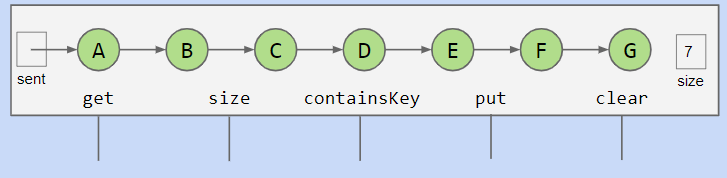
我们在使用有序的LinkedListSet时,如果要寻找一个值,通常会使用for loop,需要linear time,是否有一种方法提高搜索的效率?因此产生了Binary search trees.
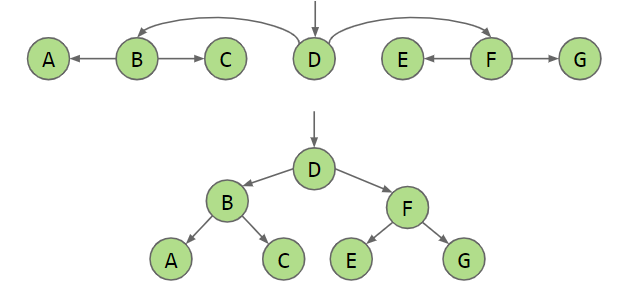
首先回顾一下原始的Rooted trees.
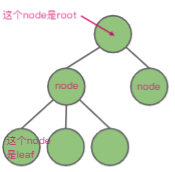
↑↑(rooted trees)↑↑
- 除了root以外的每个node只有一个parent。
- 最顶上的那个node通常被视为root。
- 没有child的nood被称为leaf。
- 任意两个node之间,只能有一条路径。
- 每个node的值被称为label.
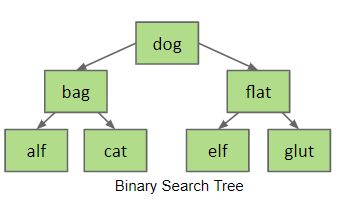
Rooted Binary search tree 除了拥有以上rooted trees的特征外,
- 所有node都不能有重复。
- 每个node只有0,1 或 2个children.
- 每个node的左分支都小于这个node,右分支都大于这个node。
II. 内容
1. Search operation原理
出发点(递归原理):
如果label等于目标值,则return.(base case)
- 如果label大于目标值,搜索左边分支
- 如果label小于目标值,搜索右边分支
Pseudo code:
1
2
3
4
5
6
7
8
9
10
static BST find(BST T, Key sk) {
    if (T == null)
        return null;
    if (sk.equals(T.key))
        return T;
    else if (sk ≺ T.key)
        return find(T.left, sk);
    else
        return find(T.right, sk);
}
2. runtime
在最差的情况下,也就是搜索值不在该binary search trees里,runtime为 Θ(logN).
3. Insert operation原理
Search for key.
If found, do nothing If not found:
- Create new node
- Set appropriate link
Pseudo code:
1
2
3
4
5
6
7
8
9
static BST insert(BST T, Key ik) {
    if (T == null)
        return new BST(ik);
    if (ik ≺ T.key)
        T.left = insert(T.left, ik);
    else if (ik ≻ T.key)
        T.right = insert(T.right, ik);
    return T;
}
4. Delate operation原理
3 possible cases:
1.Deletion key has no children.
- Directly delete its parent pointer. 2.Deletion key has one children.
- Reassign the parent’s child pointer to the node’s child. 3.Deletion key has two children.
- 选左边的最大数,右边的最小数。这俩数都不会有两个children
5. 源代码
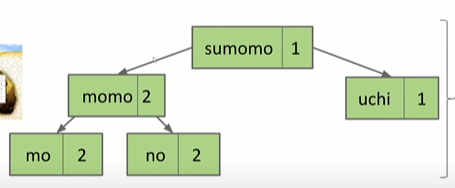
III.如何用Binary search trees表示map
IV.Some terminology for BST performance:
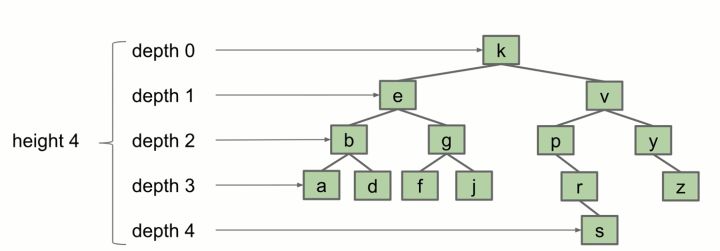
- depth: the number of links between a node and the root.
- height: the lowest depth of a tree.
-
average depth: average of the total depths in the tree. You calculate this by taking
where
is depth and
is number of nodes at that depth.
The height of the tree determines the worst-case runtime, because in the worst case the node we are looking for is at the bottom of the tree.
The average depth determines the average-case runtime, average-case = average depth + 1.